The frontier promised opportunity but for women, it demanded everything.
In The Peacemaker’s Wife by Julie Dorsey, readers are transported to a time and place where rules were few, danger was constant and survival depended not just on strength, but on resilience of the deepest kind. This powerful novel explores a question often overlooked in tales of the American frontier: what did it truly take to be a woman in a lawless land?
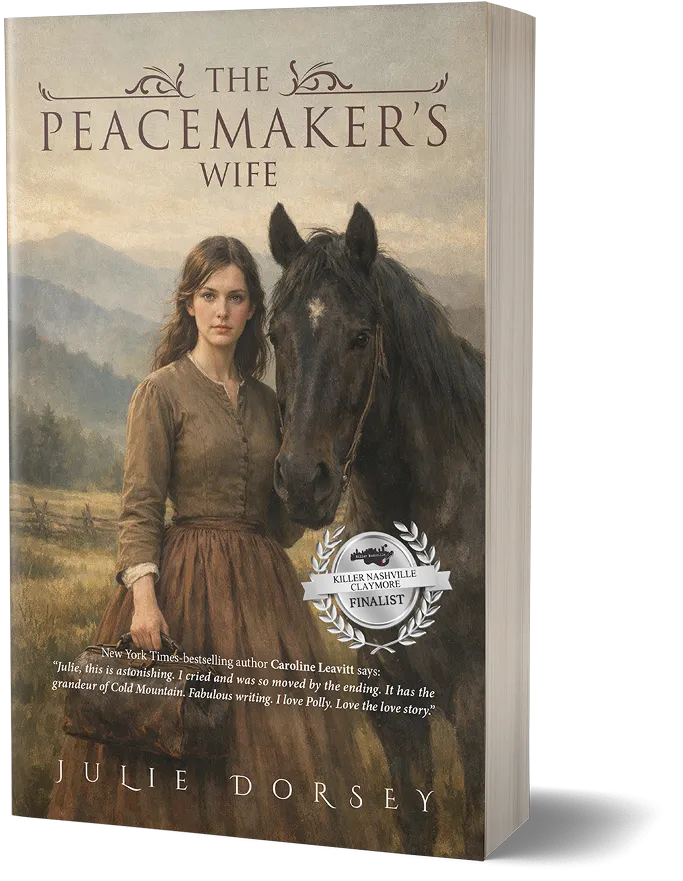
The answer is not simple and it is not easy.
Life in the 1800s frontier was shaped by unpredictability. Towns rose and fell, justice was inconsistent at best and violence was never far from the surface. For women, these conditions created a reality where safety could not be assumed and independence came at a cost. The Peacemaker’s Wife does not shy away from this truth. Instead, it brings readers face-to-face with the emotional and physical challenges women endured in a world that offered them little protection.
At the center of the story is a woman who must navigate this harsh environment while carrying burdens of her own. She is not just surviving the dangers around her; she is confronting the limitations placed on her by society, by circumstance and by her past. Through her journey, the novel reveals the quiet, often invisible strength required to endure such a life.
Because strength, in a lawless land, looked different.
It wasn’t always about fighting back or standing tall in defiance, though those moments had their place. More often, it was about persistence. It was about knowing when to speak and when to stay silent. It was about adapting, enduring and finding ways to maintain a sense of self in a world that constantly threatened to take it away.
Julie Dorsey captures these nuances with remarkable depth. The protagonist’s experiences reflect a broader truth about women of the frontier: they were not passive figures in history, but active participants in their own survival. They made difficult choices, formed complex relationships and found ways to exert influence even in systems that limited their power.
The “lawless” nature of the land adds another layer to this struggle. Without consistent structure or protection, morality often became subjective, shaped by necessity rather than principle. In such an environment, women had to navigate not only external threats but also the ethical complexities of survival. The Peacemaker’s Wife explores these tensions with sensitivity, showing how survival sometimes required compromises that left lasting emotional marks.
Yet, despite the harshness of this world, the novel is not without moments of connection and hope.
Relationships, whether built on trust, necessity or something in between, become lifelines. They offer glimpses of humanity in an otherwise unforgiving landscape. But even these connections are layered with complexity, shaped by fear, vulnerability and the constant awareness that everything could change in an instant.
What makes The Peacemaker’s Wife so compelling is its ability to balance realism with emotional depth. It doesn’t romanticize the frontier, nor does it reduce its characters to simple archetypes. Instead, it offers a nuanced portrayal of what it meant to live and survive as a woman in such a world.
For modern readers, the story resonates on a deeper level. It serves as both a window into the past and a reflection on the enduring nature of resilience. The challenges may look different today, but the strength required to face them remains strikingly familiar.
This is more than a historical novel; it’s a tribute to the women who endured, adapted and persisted in one of the most unforgiving chapters of history.
And it’s a story that proves survival, in any era, is its own kind of courage.
Step into the shadows of Blue Ridge and uncover the truth today. https://www.amazon.com/dp/B0GHKW5LCV/